Masks & Character
How Silhouette Shapes a Masked Character
Before ornament or color, the outer contour determines whether a mask reads as quiet, guarded, comic or imposing at stage distance.
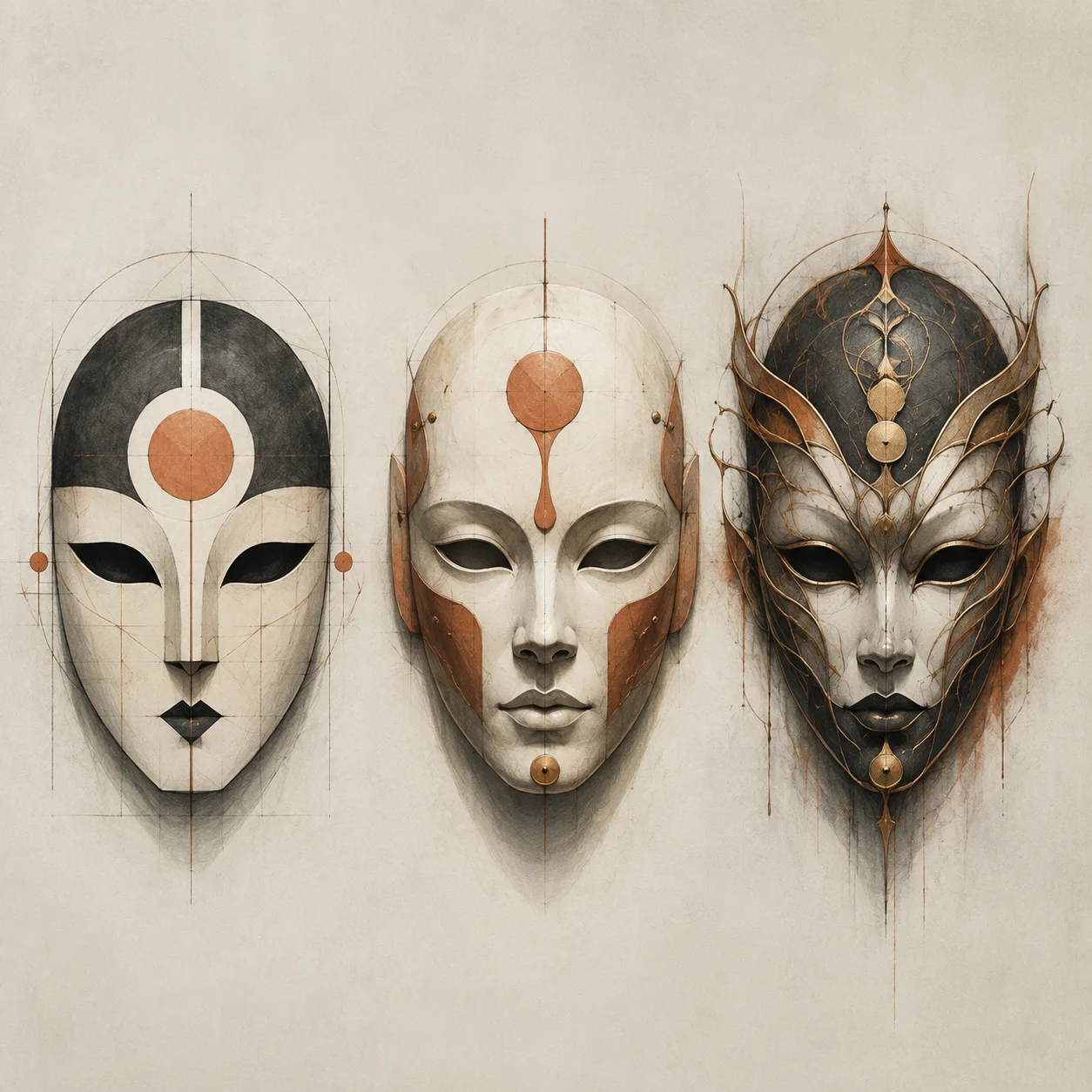
A mask first reaches the audience as an outline. From the back of a room, a fine crackle finish may disappear, but the width of the brow, the drop of the jaw and the rhythm of the outer edge remain. Silhouette is therefore a practical design test, not a claim that one outline has a universal emotional meaning. It helps a team decide what the character must communicate before small details are added.
Reduce the design to one shape
Fill the mask with a single dark value and view it at thumbnail size. Ask whether the forehead, cheek and chin make a clear sequence. A narrow lower half may feel visually quick because the contour converges; a broad jaw may feel visually settled because more mass remains near the base. These are compositional observations, not psychological measurements.
The National Gallery of Art defines shape through its boundary and uses close looking to compare geometric and organic forms. That vocabulary is useful here. A mask can combine a regular central axis with organic interruptions at the temple or crown. The question is not which category wins, but whether the transitions support the stage role and remain legible from the intended distance.
Design negative space with the face
Eye openings, mouth gaps and the space between a crown and the head all belong to the silhouette system. They influence visibility and ventilation in a physical stage object, while in illustration they control contrast and focus. Treat each opening as a designed shape instead of cutting holes after the exterior is complete.
Test the mask on both a light and dark field. A protruding edge that looks graceful on white can merge into a black costume. Conversely, a broad dark mask may need a pale rim or a break in the headdress to remain distinct. The V&A costume collection demonstrates how a performance character is assembled from multiple worn elements; the mask must be evaluated with costume, body and background rather than as an isolated icon.
Use proportion to control emphasis
Choose one dominant zone. A high crown directs attention upward; extended cheek planes widen the face; an elongated chin pulls the composition down. If every edge expands, the form becomes noisy. One strong move, supported by quieter secondary contours, gives the audience a path through the character.
The three concepts in our silhouette study share the same frontal format but distribute mass differently. The left design is nearly flat and graphic. The middle uses a calmer oval with small lateral additions. The right expands at the brow and tapers below. They are contemporary exercises, not reconstructions, and the comparison describes only what is visible.
Carry the contour into performance
Make a paper or card mock-up at real scale before committing to a sculpted version. Check sightlines, head movement and how the edge meets hair, hood or costume. A beautiful profile that blocks peripheral vision may need revision. A digital concept sheet cannot replace fitting, movement testing or a maker’s safety assessment.
Document each change. Photograph or scan the front, three-quarter and profile views under neutral light, then note the intended performance distance. V&A curatorial material on capturing performance emphasizes the value of designs, costumes, recordings and marks of use together. A final stage photograph is important, but it does not preserve every decision that produced the character.
Working takeaway
Resolve the outer contour and openings at small scale, then test them with costume, distance and movement before adding detail.
Sources and scope
These references support the historical, collection and design framework. They do not endorse this publication or its illustrations.
- National Gallery of ArtThe Elements of Art
A museum teaching framework for discussing color, line, shape, form and texture as observable visual elements.
- Victoria and Albert MuseumCostume — Explore the Collections
Overview of the V&A Theatre and Performance costume and accessory collections, spanning stage and screen practice.
- Victoria and Albert MuseumCapturing Performance
Curatorial explanation of how costumes, scripts, set designs, recordings and traces of use document performance.