Stage Design
From Sketch to Stage: Developing a Mask Concept
A useful concept process moves from research and thumbnail silhouettes to material trials, fittings, lighting tests and final documentation.
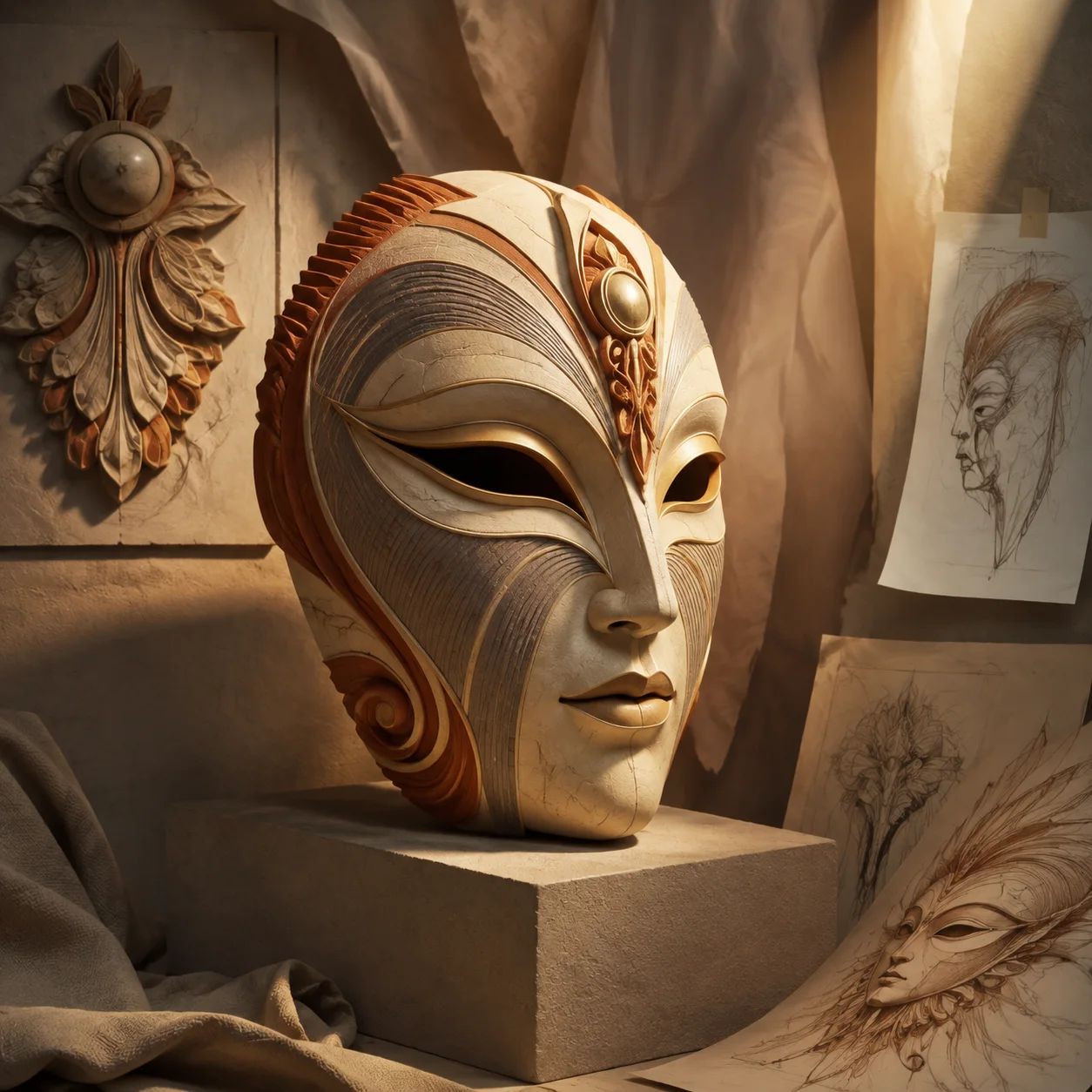
A stage mask is never only a front view. It belongs to a moving performer, a costume, a lighting plan and a specific viewing distance. Concept art can establish a strong visual proposition, but a production-ready object requires collaboration and tests. The sequence below is a framework, not a universal making method: materials, safety requirements and traditions differ, and specialist makers should define the actual fabrication process.
Write the design question
Start with the character’s function in the production. What must remain legible when the performer crosses the stage? Which part of the face can be covered? How does the mask enter, move and leave? A short written brief prevents the drawing from becoming a catalogue of attractive details with no performance job.
Research should include the script, director’s concept, costume palette, set model and available lighting positions. If historical references are used, record their institution and object data. If the project is wholly contemporary, say so. Inspiration does not need a fabricated past to feel substantial.
Move from thumbnails to a turn
Draw several small black-and-white silhouettes before refining one. Then create front, profile and three-quarter views with matching landmarks. This exposes collisions between the brow, cheek and costume and gives a maker more information than a single dramatic rendering.
Erté’s 1926 design for The Mask, documented by The Metropolitan Museum of Art, is a real stage-design record rather than a finished performance object. It reminds us that a design drawing is evidence of a proposal at a particular moment. Our warm-light image plays the same conceptual role for this draft, but it is newly generated and not connected to a real production.
Test material and movement
Create safe samples for color, surface and edge treatment, then inspect them under the planned light. A pale finish may turn amber; a glossy groove may flare; dark texture may collapse into one mass. A rendering can predict these effects but cannot replace physical testing.
Fit and movement tests belong to qualified production practitioners. Weight, ventilation, visibility, attachment and skin contact must be evaluated with the performer. The V&A’s conservation account of a latex theatre mask shows how real material behavior becomes part of an object’s history; it also demonstrates why a digital look should not be described as if it proves a physical substance.
Document the final state
Keep the brief, dated sketches, material notes, fitting changes, cue references and final photographs together. The V&A’s Capturing Performance display explains how multiple kinds of evidence help reconstruct an event after it ends. A clean archive records not only the hero image but also the decisions and revisions around it.
Credit every contributor according to the production’s actual roles. Name the designer, maker, performer, photographer and rights holder only when verified. If those names are not available in a draft, use role placeholders rather than inventing biographies or folding every contribution into a vague studio credit.
Working takeaway
Treat concept art as the beginning of a collaborative stage process: test scale, material, sightlines, light and movement, then archive the decisions.
Sources and scope
These references support the historical, collection and design framework. They do not endorse this publication or its illustrations.
- Victoria and Albert MuseumCostume — Explore the Collections
Overview of the V&A Theatre and Performance costume and accessory collections, spanning stage and screen practice.
- Victoria and Albert MuseumCapturing Performance
Curatorial explanation of how costumes, scripts, set designs, recordings and traces of use document performance.
- The Metropolitan Museum of ArtStage Set Design for “The Mask”
Collection record for Erté’s 1926 stage design, useful as a documented example of a performance concept drawing.
- Victoria and Albert MuseumDisguising Degradation: The Treatment of a Latex Theatre Mask
A conservation case study showing why material, production evidence and condition matter when describing a physical theatre mask.